







Last week's standoff between Russia and Belarus over oil was a familiar scenario. In January 2006, a similar conflict between Russia and Ukraine resulted in a several-day halt in natural-gas supplies to Poland. Russia's latest spat has reignited fears about Poland's energy and fuel security.
Although the three-day cutoff resulted in little more than an exchange of harsh words, it was an uncomfortable reminder that 95 percent of Polish oil imports and some half of the country's gas imports come from what is a consistently unreliable source - Russia. Prime Minister Jarosław Kaczyński said the stoppage was "not dangerous," adding that Poland could alternatively obtain oil by sea. Experts were also also phlegmatic. "It was more of a distortion than a crisis," says Urszula Cieślak, an analyst at BM Reflex, a company offering complex services for the fuel sector.
Strategic supplies
However, Cieślak added that a longer-term halt to the flow of oil could complicate the situation. "The problem would be if we had to reach into the state's strategic supplies," Cieślak explains. Fuel producers' operational supplies could last for a few weeks, and the state's strategic emergency reserves are enough to keep the country going for another 80 days, but this will soon change to 90 to be in line with EU law.
"This is plenty of time to arrange for importing oil through the Naftoport [which handles crude oil products in the Gdańsk port]," Cieślak says. But if the state's emergency supplies are seriously depleted, then the need to replenish them would result in an increase in fuel prices. Moreover, overseas oil tends to be more expensive than Russian oil, which would mean a further rise in prices.
Last week's events are another warning, claims Cieślak, that Poland should consider diversifying not only its sources of energy, but also its fuel-transfer routes. As the supplies coming through Belarus become less stable, Cieślak says that Poland should seriously consider increasing the amount of oil imported by sea. "This could even be Russian oil. For example, the Mazeikiu refinery gets Russian oil from the port in Butinga," she points out.
Looking abroad
But with Poland so dependent on Russian oil, many argue Poland should look to other countries to source its crude.
"One has to consider the economic cost-benefit calculation," Cieślak says. She points out that the fact that oil from overseas is more expensive than Russian oil needs to be considered, along with sea-transport costs and Poland's oil infrastructure. "Our refineries are designed to get the most out of Russian oil," Cieślak says.
Independent fuel-market expert Paweł Mosak also questions the economic benefit of diversifying oil sources. "We can get oil from other sources, but why do it if you can pay less [for Russian oil]?" he asks. He argues that the way to ensure energy security is to increase the state's strategic reserves. Mosak points out that although it seems Polish refineries are heavily dependent on Russian oil, in fact Russia is dependent on Poland as a transit country: "Around 20 percent of the oil Russia exports goes through Poland."
Nevertheless, the main players on the Polish fuel market are starting to look towards other oil-rich countries. Lotos signed a contract with the Kuwait Petroleum Corporation last August and is now receiving oil from the country. Lotos also plans to get access to oil fields in Kazakhstan. In the company's strategy through 2012, one of the key topics is diversifying the sources of oil so that a maximum 60 percent would come from one country.
Smart moves
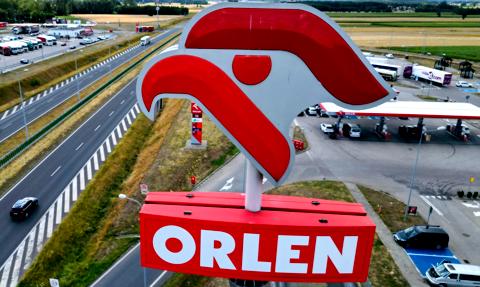
Polish fuel-market leader PKN Orlen already knows how serious a halt in supply can be. After it acquired the Lithuanian Mazeikiu refinery last year, the flow of oil from Russia to the refinery was halted and the Polish firm was forced to bring in oil by sea. The company's president, Igor Chalupec, said that apart from the crude from Russia and Venezuela, it could bring in oil to Mazeikiu from the Middle East, although he didn't disclose with which country talks are being held. The president also announced that Orlen will look for its own oil fields, but didn't disclose any further details.
Experts see this as a wise step. "It gives the company an element of stability and changes the way it is seen by others," Cieślak claims. But the advantages go well beyond perceptions. "Having access to oilfields in North Africa or the Middle East, Polish fuel companies could swap the oil extracted there for oil from the North Sea, which could be easily transported to Gdańsk's Naftoport," Mosak says. Apart from the possibility of swapping the oil, in emergency cases it could be imported directly to Poland.
By land and by sea
Poland's gas monopoly, Polish Oil and Gas (PGNiG), has taken serious steps to avoid any gas shortages in case the transfer of fuel from the east comes to a halt. At the end of 2007 or in early 2008 the company will begin the construction of a Liquefied Natural Gas (LNG) terminal in �winiouj�cie. The terminal is expected to be completed in 2011 at a cost of EUR 350 (zł.1,358) million.
"It will help increase the country's energy security through the diversification of natural gas supplies and will cater for the increasing demand for natural gas," Małgorzata Polkowska, from PGNiG's department of communication and investor relations, explains. She disclosed that the company has already begun talks with potential LNG suppliers, but didn't want to disclose the partners nor how advanced the talks are.
Recently, media sources have pointed to Algeria, whose Energy Minister is due to hold talks with Economy Minister Piotr Wo�niak this week. PGNiG is also analyzing the the possibility of getting natural gas from Norway.
For several years there has been talk of extending the Odessa-Brody pipeline to the Polish border, which would enable oil from the Caucasus to flow to Poland. But Cie�lak underlines the price factor. "We can't afford it, we would need Europe to help us," she claims, but adds that "any pan-European energy strategy should consider this option."
Mosak takes a different view. "I would like [the Odessa-Brody pipeline extension] to be a business undertaking rather than a political one," he says. Mosak claims no company has yet declared that it would provide oil to flow through the pipeline: "What we might get is a pipeline with no oil." He also underlined that Russia considers the Caucasus, as well as Ukraine, within its sphere of influence and therefore he finds it hard to imagine that the international oil concerns that are presently there would risk damaging their relations with Russia, where they are making a fortune.
Nuclear option
A step towards greater energy security was taken last week, when four leading energy companies from Poland and the three Baltic states met in Warsaw to discuss establishing a consortium to build a new nuclear power plant in Ignalina in Lithuania, where an existing nuclear plant is due to be shut down by 2009.
According to the plans, the new reactor would be built by 2014 or 2015. The president of the Polish Power Grid (PSE), Jacek Socha, explained his company's interest in the project: "As a company selling energy we want to have access to cheap energy ... Such cheap energy can only come from blocks producing nuclear energy." PSE established a team of experts to carry out a study of the new project and by the end of the month it is due to present its recommendations. A decision as to whether Poland will join the Baltic states in the project will be made this year.
Poland's participation in developing nuclear energy has the government's support. During his policy declaration in July, Prime Minister Jarosław Kaczyński called for the development of nuclear energy in Poland. During his visit to Lithuania in December, the possibility that Poland could join in the Ignalina project was announced.
EU action
Last week's furor again raised the issue of a common EU energy policy, something the Polish government has been lobbying for since last year's gas crisis. "It shouldn't be like this. This is a problem and we're saying it in Poland and in Europe. I think it is being understood more clearly," Prime Minister Kaczyński said last week.
Indeed, the European Commission heavily criticized Russia for halting the flow of oil. Furthermore, it issued a report on energy issues and priority energy projects, which mentioned the proposed Baltic pipeline. This would send gas from Russia to Germany under the Baltic Sea, bypassing Poland. Although the Commission acknowledges that the pipeline has raised a lot of controversy in Poland and the Baltic states, "from the European perspective, every new transfer line � is of utmost priority."
Mosak speculates that there could be a link between the planned Baltic pipeline and last week's events. "Perhaps the Russians want to pressure Germany to build the pipeline by proving that the Belarusian pipeline is not reliable," he muses.
Nevertheless, the Polish government's stand on energy policy is often seen as anti-Russian, and Mosak claims that this is costing Poland the chance to become a bridge between the East and West: "We are losing too much by moving away from Russia."
While some experts praise Polish companies for looking for energy sources outside of Russia, others say Poland is making a mountain out of a molehill and turning a cold shoulder to its best provider of cheap fuel.
Źródło: