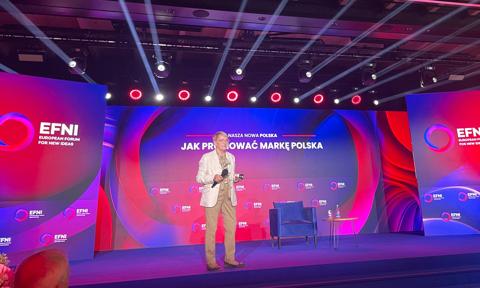







"We are highly dependent on one partner, but this is not a reliable partner and its prices are not based on competitive prices," said Vytautas Nauduzas, Lithuania's deputy minister of economy, during one of the discussion panels at the Economic Forum.
The Russian invasion of Georgia has heightened fears that Russia could use energy as a tool for political extortion against CEE countries. "This has already happened in Belarus, in Ukraine and it happened with Georgia a few years ago," Nauduzas said.
The other side of the coin
Not everyone at the Economic Forum was negative about Europe's relationship with Russia, however. Krzysztof Spandowski, president of pipeline developer PERN Przyjaźń's board, claimed that his company's cooperation with Russia had been good.

"I'd like to say that over 45 years, in my point of view, Russia has earned a very good reputation as a supplier of oil," he said.
Sergei Komlev of Gazprom Export was indignant at anti-Russian sentiment and said that it was "strange" to hear opinions that Europe was becoming more dependent on Russia.
"If you look at actual figures, the share of Gazprom in European gas supply is declining … In 2000, Russian gas accounted for nearly 45 percent of European gas imports. Now our share is nearly 35 percent," he said during the "European Energy Mix and EU - Russia Energy Relations" discussion panel. Russia and Europe are mutually dependent on one another, Komlev added, noting that 70 percent of revenues from Russian exports come from European markets.
"We are more dependent on Europe than Europe is on us," he concluded.
Cleaning up
Regardless of concerns about Russian supplies, the CEE region undoubtedly faces a number of other energy-related challenges. Developing clean energy, meeting rising demand, as well as reducing CO2 emissions and production costs are key issues that must be tackled if CEE countries want to avoid crises and maintain GDP growth.
Price liberalization and fast-growing demand for energy have contributed significantly to rising energy costs. At the same time, the need for investment in the modernization of transmission networks and production facilities is growing.
For the relatively poor economies of the CEE region, energy prices have become a live-wire topic, so to speak. Electricity may ostensibly be cheaper in the CEE than in the West, but it is actually quite expensive if you take purchasing power into account, said Paweł Urbański, vice president of Polish Energy Group.
Emitting worries
CO2 emissions present a sizable problem for CEE countries, especially given the European Union's requirement of a 20-percent reduction of emissions by 2020. Such measures will hinder economic growth and the process of catching up with their better-developed brethren in the western EU, critics say.
"In order to grow, you need reasonable energy prices," Urbański said. "We need to explain [to the more affluent EU countries] that we are not [in the same situation] as they are. These countries grew after World War II and we also want to have that chance," he added.
Polish Economy Minister Waldemar Pawlak noted that the EU offered very ambitious solutions, but these were often "unrealistic."
For CEE countries, the cost of adopting environmentally friendly solutions will be much higher than in richer countries and will have a negative impact on economic development and living standards in the short run, Nauduzas told WBJ.
"But it will increase the quality of life in these countries in the longer run," he said.
Nauduzas added that increasing production costs would be balanced by growing efficiency in energy production offered by new technologies.
Demand for energy will be balanced by growing supply, experts said. The intense investment in energy production which is expected to take place in the near future will lead to oversupply, stimulating a decrease in energy prices, according to PGE's Urbański.
"[The energy] business swings like a pendulum," he said.
Poland's predicament
For a country like Poland, which is dependent on coal for 90 percent of its energy, the development of new energy technologies is difficult. However, Poland's reliance on coal could serve as an advantage, especially if it encourages the development of clean coal technologies and carbon sequestration. This is precisely the strategy advocated by former Prime Minister Jerzy Buzek [1997-2001], for example.
According to Economy Minister Pawlak, Poland should embrace a variety of energy sources, including clean coal, renewable and nuclear energies.
The development of the latter is a distant prospect, however. Although Poland has signed an agreement to participate in the construction of a 3,200-MW nuclear plant in Ignalina, Lithuania (to be completed between 2015 and 2018), it does not have a nuclear plant of its own.
"Even under the most favorable conditions, the process of creating a nuclear-energy plant lasts over 10 years," Pawlak said. "Meanwhile, social prejudice against the development of nuclear technologies is huge."
According to Martin Roman, president of Czech energy giant CEZ, any plan to construct a nuclear power plant may become even more difficult in the future because growing demand for nuclear energy will strain the industry's resources.
"Finding qualified engineers in five years' time will hardly be possible. The sooner a country starts such a project, the better," he said.
In search of efficiency
Another facet of energy policy which needs to be addressed is consumption efficiency, speakers at the Economic Forum agreed.
"We are using twice as many resources to produce one unit of GDP than western EU countries," Lithuanian Deputy Economy Minister Nauduzas told WBJ. He noted that Lithuania will see huge investments in energy-saving projects over the next few years, including €13 (zł.44.2) billion in modernizations of 30,000 multi-family housing units.
Consumption efficiency is also of concern in Poland, and there has been some limited success here. According to Economy Minister Pawlak, GDP is growing faster than energy consumption, for example.
Regional cooperation
In the end, however, the region's attempts to bolster energy security will require more than just investments in efficiency, renewable energies or nuclear power plants, Nauduzas told WBJ.
"We should think about the synergy of all countries in the region, or at least those that are in the EU," Nauduzas said. There should be more infrastructure connections throughout the region, he added.
Such cooperation is vital, especially since no country will be able to achieve total energy independence, Nauduzas noted. "This is impossible even for Russia," he said.
Intra-European cooperation is hampered by competing national interests, though. According to Christopher G. Nicholson of Deloitte, each country in the EU needs to look after its energy security, but within the EU context.
"Poland has different motivations and should look at its own needs first and then arrange their deals though the EU," he told WBJ.
But according to Nauduzas, the recent Russian-Georgian conflict has the potential to bring European countries together. "Europe needs a more united stance on energy," he said.
Opportunity in difficulty
There is a good chance that such a policy could be developed among CEE countries, whose memories of the Soviet Union are fresh and largely negative. Politicians have already declared a desire to improve regional cooperation, and not only in the area of energy. President Lech Kaczyński, for one, has talked of building a strong Central Eastern European bloc, while other politicians have stressed the importance of increased regional contact.
"We need to carry out an open policy of cooperation," said Economy Minister Pawlak, stressing the region's great potential. "The CEE is treated as a 'fly-over region' by Western Countries and Russia. Meanwhile, the region comprises 12 countries, nine of which are in the EU. This amounts to 160 million people, more than Russia has," he noted. Pawlak stressed however, that the CEE region's potential could only be tapped if countries became active, rather than passive.
Lithuanian Deputy Economy Minister Nauduzas remained optimistic, despite all the talk of difficulties facing the region.
"According to Winston Churchill's saying, 'an optimist sees the opportunity in every difficulty.' We are searching for opportunities," he said.