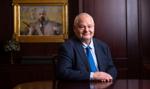







PiS deputy and economy expert Kazimierz Marcinkiewicz puts it in very strong words: "If I were a member of [Russian firm] Gazprom's board I would have never thought of a better scenario. In the privatization process it was indispensable to separate the transfer infrastructure. Two grave mistakes were done in this process."
The first mistake, according to him, is the leasing of the domestic transfer infrastructure to Gaz System. The company is 100-percent owned by the State Treasury. However, it leases the bulk of its infrastructure from PGNiG, which still owns the infrastructure. The second blunder is that the privatization includes PGNiG's shares in EuRoPol Gaz, the owner of the Polish segment of the Yamal pipeline. This vital link goes from Russia through Poland to Western Europe. PGNiG has a 48-percent share in EuRoPol Gaz. This, according to Marcinkiewicz, could enable Russia's Gazprom to get control over EuRoPol Gaz and large shares in PGNiG, and consequently over the domestic gas-transfer infrastructure.
Political energy
PO and PiS caused a political storm recently when they said that if they take power in the general elections, which looks like a dead cert, they will renationalize part of PGNiG's assets. The gas giant's board ignored the threat and refused to amend the firm's issue prospectus to include this as a new risk factor. Marcinkiewicz says that it is just the transfer-infrastructure ownership that his prospective coalition are interested in protecting. "We will try to make sure that within a year the transfer infrastructure will be in the hands of a state company," he said. Nationalizing PGNiG's stake in EuroPol Gaz is also on PIS' agenda. The party is not against the whole privatization process, although they claim that it shouldn't have been carried out two days before the elections.
Initially there were fears that these declarations would scare off potential investors even though opposition parties promised compensation to those whose shares would be nationalized. However, despite the analysts' worries, the demand for shares has been huge. A reduction for the individual clients has reached 92 percent, and over 130 corporate investors (more than 50 percent were from Great Britain) signed up for the shares.
"This is the largest public offer and institutional investors just must have this investment in their portfolio," Piotr Janczak from DB Securities said. He added that they are motivated by a clear economic interest. "They see the offer. Individual clients on the other hand often do not have a clue about the ongoing political turmoil," Janczak added. He declined to speak about the opposition's accusations that the privatization poses a threat to the country's energy security.
It is estimated that PGNiG could make as much as zł.1.2 billion more than the initially expected zł.1.5 billion. That means more funds for the company's ambitious investment plans.
PGNiG plans to spend zł.8.75 billion on investments and the funds raised from the IPO will certainly not be enough to cover this. But the company's president, Marek Kossowski, sees the bourse debut as the next step on the "right path of development," that took PGNiG from the brink of bankruptcy, where it stood at the beginning of the decade with over a hundred loans and a debt exceeding zł.6 billion. From a net loss of over zł.162 million in 2001 the company bounced back to make zł.1.1 billion in profit in 2004.
"We are generating profit and we will increase our capital resources with the funds from the IPO, which will help us acquire loans more easily," Kossowski says.
Diverse sources
Over 40 percent of the funds raised from the IPO are planned to be invested in searching for and extracting oil and natural gas. PGNiG sees Poland as vital in its strategy of diversifying its energy sources and plans to increase domestic extraction of gas and oil. "Our main goal is increasing the extraction of gas in the country to 5.5 billion or even six billion cubic meters in 2008-2009," Kossowski said. In addition the company is targeting an increase in domestic oil production from the 2004 level of 624,000 tonnes to around 1.4 million tonnes.
According to PGNiG sources, while Russian gas made up over 86 percent of Poland's imports in 2002, that share fell to just under 62 percent last year. On the other hand, PGNiG has been importing more gas from Central Asian countries. Last month, the monopoly signed a short-term contract with Swiss-based RusUkr-Energo AG for the supply of three billion cubic meters of gas until the end of 2006. What's more, PGNiG is considering engaging in two projects that would further decrease Poland's reliance on Russian gas. The Nabucco pipeline would supply Europe with gas from Iran, which has the second largest gas reserves in the world, while the Sarmatian pipeline is to deliver gas from the Caspian Sea region. "We are in the process of acquiring the projected pipeline's documentation," said Kossowski with regards to the Nabucco project.
A decision is expected after PGNiG analyzes whether it will be merely a receiver of the Iranian gas or if it will join the project as an investor. The importance of the Polish gas monopoly's interest in the two Central Asian projects has risen, especially in light of the construction of a Baltic pipeline that will transfer Russian gas directly to Germany.
The German link
A further step towards diversification of sources was taken when PGNiG and German VNG signed an agreement to build an interconnector pipeline that will join the Polish and German gas systems, enabling gas from Western Europe (particularly from Norway) to reach Poland starting from the end of 2006. "In the initial stage the pipeline will make it possible to import between one and two billion cubic meters of gas, but its technical capacity should allow for the transfer of five to six billion cubic meters," Kossowski said.
While gas from Norway and Central Asia has already been imported by Poland, new suppliers are sought after. This year saw an intensification in Polish-Ukrainian cooperation in the gas sector. This month a new gas pipeline was launched in the Hrubieszów region in southeastern Poland through which Naftogas will send gas to the area, which remains uncharted territory as far as gasification is concerned. But more can be expected from the cooperation with Poland's eastern neighbors. "We are interested in searching for and extracting oil and gas in Ukraine," Kossowski said.
Alternative thinking
In October PGNiG plans to sign a letter of intention to build a Liquefied Natural Gas (LNG) terminal in Poland. The estimated cost of the undertaking may reach E500 (zł.2,000) million. The gas monopoly's input could amount to E300 (zł.1.200) million. This expense could soon pay off since the price of LNG in Europe doesn't exceed $150 for 1,000 cubic meters, while Poland pays around $200 for the same amount of gas from Russia. The investment could be completed by 2010.
Growth prospects are looking good for the market and the monopoly. By signing a letter of intention with Poczta Polska to convert its fleet of vehicles to Compressed Natural Gas (CNG) the company entered a market with large prospects as gas is an increasingly popular choice as a petrol or diesel substitute. PGNiG offers methane as a fuel and according to Kossowski it's more environmentally friendly. "We would like to sell gas as a fuel on a larger scale," he said, adding that apart from Poczta Polska, the company is holding talks with large state-owned enterprises and several cities to supply their vehicles with gas fuel.
Using gas in electric energy and heating is also a segment with huge prospects. As Kossowski underlined, Poland is still coal-oriented in electricity and heating generation, while in the West natural gas is increasingly popular in this field. This explains the enormous difference in natural gas consumption between Poland and some Western European states. Poland consumed 13.6 billion cubic meters in 2004 while in Germany the figure reached over 85 billion cubic meters a year before.
Regardless of the IPO's success, Kossowski is under no illusions about his future, and many expect widespread changes at the top after the elections, which could see the entire board replaced. "The company is in a healthy financial position," he says, adding that his successor will have their work cut out in working to diversify PGNiG's sources.
As the countdown begins to the long-awaited privatization of PGNiG, the political row surrounding the sale is intensifying. Both the parties expected to lead the country after the election have slammed the flotation as a risk to energy security that could enable Russia's Gazprom to gain control over the domestic gas infrastructure. However, threats to renationalize PGNiG assets have done little to dampen enthusiasm for the IPO
Źródło: