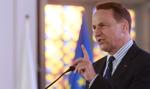

The Irish Prime Minister was in Warsaw recently to receive an award from the Business Center Club for his contribution to the Irish economy. After meeting with Marek Belka, he received a ringing endorsement from his Polish counterpart, who said: "Ireland is an example of huge success and a source of inspiration to Poland. In a dozen years, perhaps Poland will be talked about as a European miracle."
Not everyone here is happy to follow Ireland's lead, however, with some economists calling for a new radical economic philosophy to help Poland catch up with, and overtake, its EU neighbors. Poland can certainly learn from the Irish model, but many believe it will take some original ideas to fuel a Polish economic revolution.
Improving on the Irish
For Dr Robert Gwiazdowski, of the Adam Smith Institute in Warsaw, the answer to Poland's prayers lies a little closer to home.
"We shouldn't follow Ireland's example because we have one of our own. We have a better situation than in Ireland because we have had large increases in national income in a much worse situation than Ireland. In the 1990s we had no cars, phones, or roads but the speed of growth went at about six to seven percent."
However, the two countries' situations post-EU membership are strikingly similar.
In 1973, Ireland had just joined the European Economic Community, the forerunner to the European Union. The country was heavily in debt and the government put its faith in Keynesian principles for economic growth. Unemployment was rife and the country still struggled to find its place, having emerged from the shadow of its neighbor, Great Britain, as an independent political and economic entity.
Mirror images
Although Poland has been flashing its new EU membership card for almost 10 months, unemployment is doggedly loitering at 19 percent. The government is struggling to get its national debt to a more manageable level, ahead of eurozone entry, and the much-hyped Hausner Plan is set to miss its targets by about 50 percent. Communism was jettisoned in the 1990s and now the country is hungry for independent economic growth.
To sate their appetite, many politicians and economists have been looking up the menu of reforms Ireland implemented that nursed the economy from a mewling kitten in the 1980s to the roaring 'Celtic Tiger' of the 1990s. Low corporate taxes, together with low labor costs and a strategic position on the periphery of Europe tempted a slew of foreign companies to the Emerald Isle. State subsidies sweetened the deal, and a major boost from EU structural funds gave the country's government the means to establish a modern infrastructure to cope with these new industries. Projects such as the Irish Financial Services Center (IFSC), which is now the economic and financial heart of the country, gave the polish to the paintwork on the Irish economy's chassis. When the Celtic Tiger began to bite, the government took advantage and Charlie McCreevy-voted the most successful Irish Finance Minister of all time by Finance magazine-slashed the budget deficit and steadied the Irish ship through spectacular economic growth in the 1990s.
Language barriers
David McWilliams is an Irish economist and journalist and was one of the first to see the Irish economy's potential back in 1994 when he said it would grow like "an Asian Tiger," hence the term, Celtic Tiger. He believes that some of the Irish lessons to be learned by Poland are somewhat simple.
"To be very glib, Poland needs to learn English, because nobody should underestimate the role the English language had in Ireland's economy. Think of the huge amounts of [foreign] capital that come into Ireland, as well as foreign young people; one of the main reasons is because we speak English. A lot of middle management in English-speaking companies may not want to go to Poland because of this."
The language barrier is not the only problem facing Poland. "The population structure is quite old, which is more typical of Central Europe than the Western world and you don't get the same dynamism," he says. "[In Poland] the best and the brightest go abroad and you have a very serious brain drain. You are hollowing out the marrow of the economy, which is retarding development."
Before the roar
In Warsaw, Irish Prime Minister Ahern said that it was not simply a case of looking at Ireland as a case study. "Some people believe that Ireland joined the EU and the following morning they got up and everything was solved. We were 15 years in the EU and many things went from bad to worse. It was when we started taking the difficult decisions ourselves ... that we managed to change things around, obviously with the help of the EU."
McWilliams echoes this view. "One of the great myths propagated by the EU is that the Irish example is easily replicated elsewhere in Europe. If you look at Greece or Portugal, they haven't produced the same sort of economic growth with precisely the same sort of incentives."
Difficult decisions seem to be very much on the agenda for the next Polish government.
Gwiazdowski says: "Firstly, the main problem with Polish finance is with distribution, because we use the power of the state for redistribution, not for investing in the infrastructure.
"The second problem is that we should absolutely change how social security is financed. In Poland, social security taxes are approximately 65 percent of salary. Many countries, such as France and Germany, stress that income taxes in Poland are low but social security tax is very high; if we tax the work, the labor, we have less work and labor.
"National growth does not come from spending money but from hard work by many people. If national growth was a result of spending money my wife would be the Prime Minister."
In need of a deal
Rafał Antczak, an economist with the Center for Social and Economic Research, says: "Ireland implemented complete reforms ... they rebuilt the system in a country that was similarly poor, with similar problems. The factor that sets Poland apart is that [Ireland was] in a deep crisis and [came to] a social agreement. Here, a social agreement is simply impossible ... Try to agree on social pacts with unions in the Polish energy sector-or any other for that matter."
It appears that, as in Ireland, there are no simple solutions and the economic process will be a long one. "Ireland joined [the EU] in 1972 and started reporting significant growth in 1986," says Richard Mbewe, chief economist with the Warsaw Investment Group. "It was a long time and only after society agreed on what to do. Poland has been an EU member for just a few months. It would be too early to say Poland is successful."
According to Henryka Bochniarz, the president of the Polish Confederation of Private Employers (PKPP): "We should not be expecting miracles. Anyway, we are doing everything faster than [other] countries, utilizing our strength and potential. We have to be ready for a long walk, but that is why it is so important to have this scenario, to know what is at the end."
The Krushchev case
Gwiazdowski does not see dramatic growth taking hold in the current political situation. "It's not possible with the situation we have now with Marek Belka as Prime Minister. Marek Belka is a Keynesian economist. If we built our economy based on supply-side economics the situation would be absolutely better.
"In the 1960s [Russian leader Nikita] Krushchev said how much time the Soviet Union needed to catch up with the US. But he forgot that the US would grow also. So it is impossible to change our economy using the same method that is used now in the EU, and be in the same position as the Union in the future.
"We have to change the philosophy of our economy because we have to speed up our growth to be in a better position than the old EU."
One of the main difficulties in ensuring long-term economic growth is sustaining plans despite changes in government or in influential industry positions. According to Jeremi Mordasewicz, an economist with PKPP: "Ireland achieved stunning results only after 10 years. Here, we have planning based on four-year periods. [Serious budget reform] can only be done within the first year after elections."
Know your enemy
Richard Mbewe says: "We should be conducting a dialog. The best place to do it would be the trilateral commission, but with members of the opposition. [The National Development Plan] is a very good point to start this dialog."
So would the National Development Plan offer a suitable framework for such long-term economic planning? Henryka Bochniarz sees potential in it. "It is not yet in such a shape because it does not address many issues, among others, the case for the euro. But the discussion about what should happen until 2013 is a very good occasion for considering how we should implement this long journey."
Whether or not Marek Belka's vision of Poland being regarded as an economic miracle in a little over a decade will be realized remains to be seen. However, many economists, although their feet and heads remain strictly rooted in the reality of European economics, are sanguine about Poland's prospects. "We have never, during 300 years of history, been in such a good position, but we have very big enemies," says Robert Gwiazdowski. "I think that France and Germany are the enemy of growth of the EU. This is the reason why we should cooperate with Ireland, we should cooperate with Great Britain and then with France and Germany."
Laurence Mackin

Źródło: